Knowledge article
ChatGPT Ads: how advertising in ChatGPT works and when it pays off
Ad Meisen · September 2, 2026 · Updated September 24, 2026
- ChatGPT Ads
- OpenAI Ads
- Advertising in ChatGPT
- OpenAI Ads Manager
- ChatGPT Ads Europe
ChatGPT Ads, also called OpenAI Ads, is OpenAI's advertising platform. It has been available in 31 European markets since the week of 24 August 2026, including the Netherlands and Germany. Since 31 August 2026 you can also run it yourself, through OpenAI Ads Manager at ads.openai.com. Ads appear below a ChatGPT answer, mainly for Free and Go users. You pay per click or per thousand impressions, with a minimum of €15 a day.
The question for a brand is not whether the channel is new, but whether it is commercially sound. Does the destination fit your margin, can you measure what a click delivers, and is there enough reach to base a decision on? This article explains how it works and gives a decision model for that choice.
The channel is young. Whoever tests now with a measurement plan learns sooner than the competition what a click is worth. The platform is still in beta, though: features, countries and terms change quickly. What follows comes from the official OpenAI documentation, with the source next to the claim. Where we make an assessment, we say so explicitly.
Last reviewed on 24 September 2026.
In short
- ChatGPT Ads has been available in 31 European markets since the week of 24 August 2026, including the Netherlands, Germany and Belgium. Self-serve access through OpenAI Ads Manager has been open in all of them since 31 August 2026 (OpenAI).
- Ads appear for Free and Go users, and also in logged-out use. Plus, Pro, Business, Enterprise and Edu stay ad-free, as do accounts of users under 18 (OpenAI).
- You choose from three campaign objectives: views (CPM), clicks (CPC) or conversions (oCPC or oCPM). You never pay per conversion (OpenAI).
- There is no exact keyword targeting. You steer with context hints, country, platform and, where useful, custom audiences.
- Product feeds are available for catalogue ads.
- Personalised ads are not yet available in the EEA and Switzerland.
- Accounts billed in euro have a minimum daily budget of €15 (OpenAI).
- A new self-serve account may at first only advertise in its home country. Other countries open up after identity verification and initial spend at home (OpenAI).
What is advertising in ChatGPT?
An ad can appear below a ChatGPT answer. It is visible to Free and Go users. Ads can also appear in logged-out use; they are then suitable for all ages. Plus, Pro, Business, Enterprise and Edu show no ads (OpenAI).
An ad consists of a brand name, a logo, a title, a short text, an image and a link to your destination. It is labelled as sponsored and sits apart from the answer. One answer can show one or more ads, from one or more advertisers. ChatGPT's answers stay independent of advertisers.
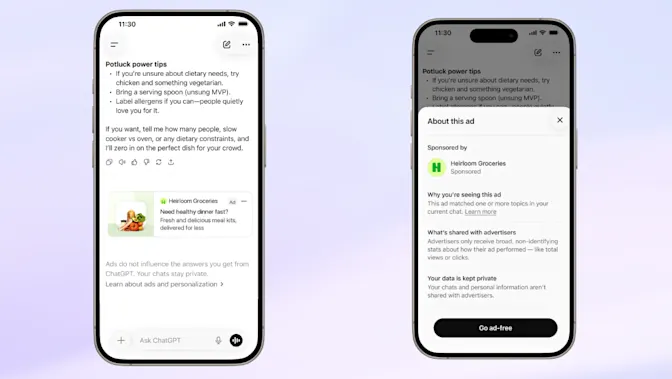
Ads do not appear near sensitive topics such as health, mental health or politics. You pay per click or per thousand impressions. There is no fixed price.
How does ChatGPT decide which ad appears?
Not your keyword, but the context of the conversation. OpenAI matches an ad to the topic and intent of an ongoing conversation. It also weighs the landing page, the ad copy, your context hints, your targeting choices and your bid (OpenAI).
You steer with context hints: descriptions of conversations, topics, needs and situations in which your product is relevant. "Cushioned everyday running shoes for beginners training for their first 5K" works better than "running shoes". Context hints are not exact-match keywords and do not guarantee delivery in a particular conversation (OpenAI).
The highest bid does not win automatically. OpenAI weighs expected relevance and outcome and uses a relevance-weighted second-price auction. A better-fitting ad can therefore deliver more strongly without having the highest bid (OpenAI).
On 24 September 2026, OpenAI's Help Center describes no keyword planner and no search term report like Google and marketplaces offer. Reporting covers impressions, clicks, cost, CTR, average CPC, average CPM and conversions. So you work with your own demand data and test it with real campaigns.
ChatGPT Ads and Google Ads: what is the difference?
The biggest difference: in Google you choose the search query you appear on. In ChatGPT you describe the situation, and the system chooses.
| ChatGPT Ads | Google Ads (search) | |
|---|---|---|
| What you steer on | Context hints about conversations and situations | Keywords with match types |
| Insight into queries | No search term report | Search terms report |
| Billing | CPM, CPC, or a conversions objective with oCPC or oCPM | CPC or impressions, with conversion bid strategies |
| Personalisation in the EEA | Not yet available | Possible, with consent |
| Measurement | OpenAI Pixel and Conversions API | Google tag, GA4 and conversion import |
For a brand this means: Google captures demand that already exists. ChatGPT comes into view while someone is still exploring and comparing. The two complement each other. So judge ChatGPT Ads not only on direct sales, but also on its role in the decision.
Which ad formats are there?
There are two ways to create ads.
Single ads. You create a title, a short text, an image and a link yourself. Useful for steering a limited number of products or offers.
Product feeds. You supply your product catalogue as a feed, and OpenAI turns it into ads at scale, with product image, title, price and rating. You deliver the feed by upload, a hosted URL or SFTP. Products expire after two weeks without a refresh, so for an ongoing campaign you automate delivery (OpenAI).
How is a campaign structured?
The structure has three levels: campaign, ad group and ad.
Campaign. Here you set your goal and budget: the objective, the budget, the run time and the countries where your ads may appear. Optionally you pick platforms (Android app, Android web, desktop web, iOS app or iOS web) and custom audiences to include or exclude. Keep one campaign to one business goal (OpenAI).
Ad group. One theme or need, with context hints that describe when your product is useful. Several ad groups let you steer themes separately.
Ad. The title, text, image and link the user sees. Several per ad group, so you can compare messages.
Custom audiences add little in the EEA and Switzerland while personalisation is unavailable there, and OpenAI advises against them. Elsewhere, an inclusion audience needs at least 25,000 matched users (OpenAI).
How do the campaign objectives work?
Your objective determines how you pay and what the system steers on (OpenAI).
- Views (CPM). You pay per thousand impressions. For reach and visibility.
- Clicks (CPC). You pay per valid click. For traffic to your site or product.
- Conversions (oCPC or oCPM). The system steers delivery towards a conversion you choose, such as a purchase, sign-up or lead. You pay per click (oCPC) or per thousand impressions (oCPM), never per conversion.
The difference between the two conversion options matters. With oCPC the system steers on conversions after a click. With oCPM it also counts conversions from people who saw the ad and came back later. According to OpenAI, oCPM therefore drives more conversions (OpenAI). A conversion after only a view is harder to prove, though. So judge the outcome in your own numbers too.
For the conversions objective you send conversion events through the OpenAI Pixel, the Conversions API or both. Only standard events are supported, not custom events. That requires a destination and measurement setup you control yourself (OpenAI).
The objective, the billing option and the conversion event are fixed after creation. To change them, you clone the campaign or create a new one. A campaign-total budget can be changed to a daily budget, but not back.
For your budget you choose a total amount or a daily budget. A total budget gives tighter control over overall spend. A daily budget is an average over seven days. Spend on a single day can reach twice the chosen amount, and stays within seven times the daily budget over seven days. The budget week runs from Sunday to Saturday. If the weekly allowance runs out early, an active campaign may pause until the next week (OpenAI).
How do you get started with ChatGPT Ads?
- Create an account at ads.openai.com. Expect identity verification. A new account sometimes advertises only in its home country at first.
- Set up measurement before any budget goes in. On your own site with the OpenAI Pixel and the Conversions API. If you send traffic to Amazon, with an Amazon Attribution tag.
- Choose the objective deliberately. It is fixed after creation.
- Create one ad group per theme, with context hints in your customer's language: needs, situations and decision moments.
- Create several ads per group, or connect a product feed.
- Start with a daily budget. Spend data runs 7 to 8 hours behind, so do not judge within the first day (OpenAI).
How do you measure the result?
Measurement comes before budget. Without reliable measurement you buy traffic without knowing what it delivers.
You measure conversions with the OpenAI Pixel, the Conversions API or both. If you send the same event through both routes, use the same event ID so OpenAI can deduplicate it. You can also track traffic with UTM parameters in your analytics (OpenAI).
OpenAI documents that measured conversions can differ because of consent, browsers, storage, attribution windows, time zones, deduplication and modelling. Your own webshop therefore gives the most measurement control. That is not the same as a complete picture.
Where do you send the traffic?
This is the core of the commercial choice. The destination determines your margin, your measurability and your steerability, and those three do not move together.
Separate two questions. They are not the same:
- Can we assess the result afterwards?
- Can OpenAI use this conversion signal to steer the campaign?
Your own webshop. The sale, the customer and the data are yours. You pay no marketplace commission. You measure most fully, with a pixel and the Conversions API, and this is the only destination where the conversions objective (oCPC or oCPM) works. The flip side: a standalone webshop often converts lower than a marketplace. And you carry the cost of payment processing, fulfilment, returns, customer service and acquisition yourself. So assess the contribution margin per order, not just the gross margin.
Amazon. Conversion is often higher, thanks to trust and purchase intent. Two things matter, and they are not the same. For assessment you can link external traffic with Amazon Attribution to product page views, add-to-carts and purchases (Amazon). For steering, those Amazon conversions are not sent back to OpenAI. A measurable Amazon sale is therefore not yet a steerable signal within OpenAI. Your margin is lower because of commission and fulfilment costs, and the customer data is not yours.
Bol. Bol offers attribution reporting for ads within its own platform, but no publicly documented counterpart to Amazon Attribution for external traffic. So you can record a click from ChatGPT, but not link it directly to a bol order. Without direct order attribution, we currently see ChatGPT Ads towards bol mainly as a channel for reach and demand building. Steering on direct sales stays limited as long as orders cannot be linked to individual clicks.
On ranking, caution is warranted. External sales that convert add to your total sales velocity, and that can go together with a stronger category rank (BSR). Amazon does not guarantee better organic positions from external traffic. We therefore treat this as a possible side effect, not a campaign goal. Traffic that bounces straight away adds no sales velocity.
Do you sell as an eligible brand owner in the US Amazon store? Then converting external traffic can, under conditions, count towards the Brand Referral Bonus. That is a discount on your selling fees (Amazon). This programme does not apply generally to European Amazon stores.
Our decision model per destination
We weigh a destination on economics and measurability: contribution margin per order, expected conversion from your own data, measurability for reporting and steerability within OpenAI. We also look at customer data, operational reliability, stock, strategic value and the risk of unmeasured revenue.
In short:
- Webshop. Highest measurement control and steerability (Pixel and Conversions API), your own customer data, usually a higher contribution margin, but often a lower conversion rate.
- Amazon. Assessment partly possible via Amazon Attribution, no direct steerability through the conversions objective, often a higher conversion rate, lower margin after marketplace costs.
- Bol. Limited external attribution, no direct steerability, mainly suited to reach and demand building.
For the economics we use one rule:
Expected contribution per click = contribution margin per order × expected conversion.
A worked example, not a benchmark. Suppose a webshop delivers €24 contribution margin per order and converts at 2.5%: the expected contribution is then €0.60 per click. If Amazon delivers €15 per order and the traffic converts at 8%, the expected contribution is €1.20 per click. The webshop keeps more margin per order. Amazon delivers more expected contribution per click in this example, thanks to the higher conversion rate.
The formula is the insight, the percentages are scenarios. Fill them with your own conversion data per destination. If that data is missing, work with several scenarios. Across the market, marketplaces often convert higher than a standalone webshop. Public figures vary widely by category and definition, though. For traffic from ChatGPT there is no stable benchmark yet.
When not to start yet
Not every brand needs to start now. We would wait in these cases:
- The contribution margin per order is unknown. Then you do not know what a click or order may cost at most.
- The only destination is a channel where you cannot measure revenue, while you do want to steer on it.
- The product or claim is not allowed or cannot be substantiated.
- There is no budget for enough delivery to make a commercial decision. One generic ad on a small budget rarely gives a usable conclusion.
- The landing page is not in order: wrong price, no stock, or a page that does not keep the promise.
The channel being new is no reason to start without a measurement plan.
A sound test setup
Test one product group and one destination first. That keeps the result traceable.
Set up your measurement before budget goes in. On your own site with a pixel and the Conversions API, or with an Amazon Attribution tag for assessment on the Amazon side. Describe your context hints per situation, in needs and decision moments, not in keywords. Create several ads per theme.
Raise the budget only when measurement quality, conversion and contribution margin stay within the limits you agreed beforehand. A daily budget gives more room to follow delivery and spend during the first test.
Treat the outcome as direction, not as a clean split test. On 24 September 2026, OpenAI's Help Center describes no separate feature for controlled experiments. Several ads can be delivered unevenly because of differences in expected relevance and outcome. Testing structural choices, such as webshop versus marketplace, usually delivers more than small variants of one ad.
Privacy and the European context
Personalised ads are not yet available in the EEA and Switzerland. Ads here therefore lean more on the current conversation and other permitted context. Check in Ads Manager which audience features are available for your account and country (OpenAI).
OpenAI documents that conversion data may only be shared where that is permitted. Inform users clearly and collect consent where the law requires it. Have the setup reviewed by the responsible privacy or legal specialist (OpenAI).
Frequently asked questions
Is advertising in ChatGPT available in Europe? Yes. ChatGPT Ads has been available in 31 European markets, including the Netherlands and Germany, since the week of 24 August 2026. Self-serve access through OpenAI Ads Manager has been open since 31 August 2026. The platform is still in beta.
How do I start advertising in ChatGPT? Create an account at ads.openai.com and set up your measurement first with the OpenAI Pixel and the Conversions API. Then create a campaign, ad groups with context hints and several ads. A new account sometimes advertises only in its home country at first.
Who sees the ads? Free and Go users, and logged-out users. Plus, Pro, Business, Enterprise and Edu show no ads, and neither do accounts of users under 18.
Does ChatGPT Ads work with keywords? Not with exact keyword targeting like Google Ads or marketplace advertising. You steer with context hints that describe conversations, topics and situations. They do not guarantee delivery in a particular conversation.
What is the difference between ChatGPT Ads and Google Ads? In Google Ads you choose the keywords you appear on and see which search terms drove clicks. In ChatGPT Ads you describe situations with context hints, and the system chooses the conversation. There is no search term report.
What does advertising in ChatGPT cost? You pay per click or per thousand impressions, depending on your objective. With the conversions objective you also pay per click or per impression, not per conversion. Accounts billed in euro have a minimum daily budget of €15. Actual costs depend on competition and relevance.
Can you send traffic from ChatGPT to Amazon or bol? Yes. The difference lies in measurement. You assess external traffic to Amazon with Amazon Attribution, although that conversion is not fed back to OpenAI. Bol has no publicly documented counterpart for external traffic. Your own webshop gives the most measurement control.
Can you A/B test in ChatGPT Ads? Partly. There is no separate feature for controlled experiments. Several ads do not get an equal, random split, because the system steers on expected relevance. Read the outcome as direction.
Is ChatGPT Ads right for my brand? That depends on your contribution margin, your measurability and your destination. With your own webshop you measure and steer most fully; a marketplace often converts higher but is less steerable. Without a known margin and measurement plan, starting is not sound.
Conclusion
ChatGPT Ads is a serious new channel, but no automatic opportunity. The result is determined by the destination, the measurability and the economics per order, not by the platform being new.
For brands with a strong webshop it is a channel to learn from early and measurably. For marketplace brands it depends on the destination. To Amazon it is assessable via Amazon Attribution, but not directly steerable. To bol you deliberately accept weaker direct attribution.
Want to determine whether ChatGPT Ads is commercially sound for your brand? We assess the contribution margin, the destination, the measurability and the marketplace impact. After that you know whether a test is worthwhile, and which route gives the most grip. Discuss the business case or read how we manage ChatGPT Ads. In our client cases you can see how we steer on visibility, conversion and margin. See also how we approach advertising on Amazon and advertising on bol, and calculate your margin on bol. Read as well how Amazon Sponsored Products appear off Amazon and why that demands extra control.
Sources
- ChatGPT Ads expands across Europe · OpenAI
- Ads in ChatGPT · OpenAI Help Center
- Ads in ChatGPT: The Basics · OpenAI Help Center
- Ads Manager Beta Overview · OpenAI Help Center
- Create Campaigns for ChatGPT Ads · OpenAI Help Center
- Create Ad Groups for ChatGPT Ads · OpenAI Help Center
- Create Campaigns from Product Feeds · OpenAI Help Center
- Conversion Measurement · OpenAI Help Center
- Conversion-optimized Campaigns · OpenAI Help Center
- Amazon Attribution · Amazon Ads
- Amazon Brand Referral Bonus · Amazon Ads